Scientific evidence guide
Collagen findings and facial claims: reading the gaps in evidence
How to read anatomical comparisons, molecular outcomes and unresolved study records before extending a finding to the face.
Published October 22, 2026 · Updated October 22, 2026 · Sources checked October 22, 2026
Public-source editorial review. No clinician sign-off, firsthand product testing or individual assessment claimed.
The protected-hip findings concern procollagen I messenger RNA (mRNA). The distinction between molecular evidence and a visible facial outcome is the starting point for this guide. A biological observation can be interesting without answering the practical question a reader brings to a facial-cream discussion. To connect those questions, we need to examine where a measurement was made, what it represents and whether the relevant comparison was actually performed. Otherwise, the conclusion may change as it travels from a research figure to an appearance claim.
This guide follows that journey through anatomical comparisons, different kinds of measurements and the records needed to interpret an experiment. Original methodological examples show why an unresolved sample count deserves attention and why two unlike observations cannot be turned into a single causal explanation. The aim is to make the gaps specific: a missing comparison, an unmeasured outcome or an ambiguous record calls for a different kind of evidence. Keeping those distinctions visible helps a clinician and reader discuss the facial question without asking a laboratory finding to answer it alone.
In this reading
Study figure and data
Protected-hip estradiol: procollagen I mRNA
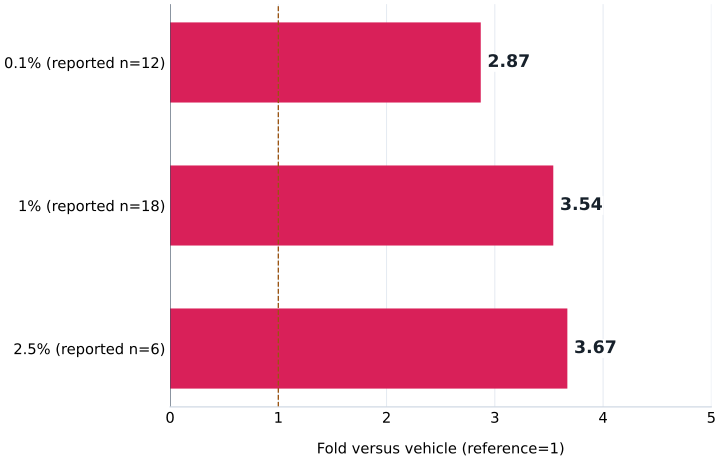
Female research samples; counts as printed in Figure 1A.
Molecular endpoint, not visible facial benefit. Original bars show SEM; confidence intervals unreported.
Download chart (PNG)Download data (CSV)Download vector chart (SVG)
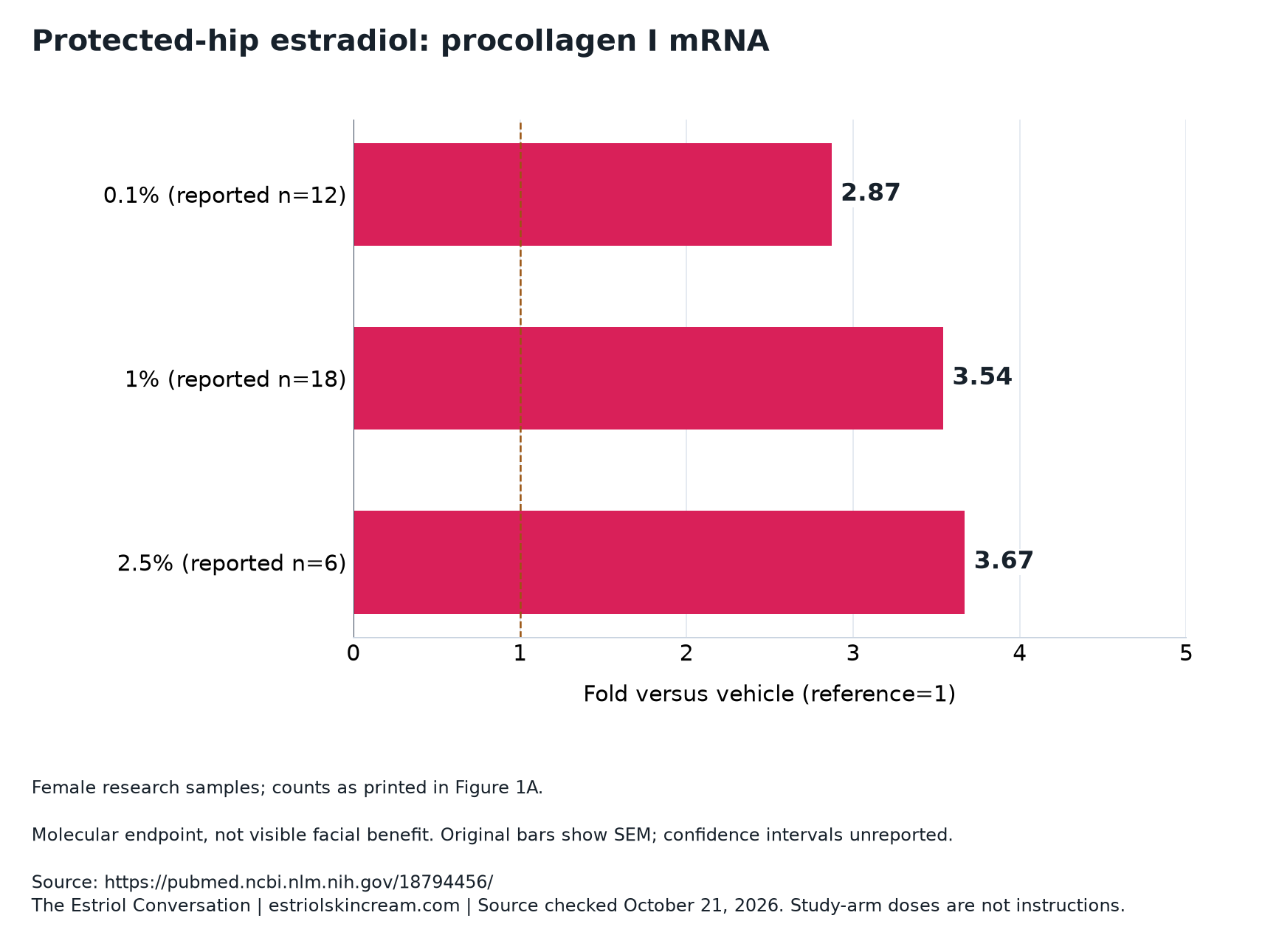
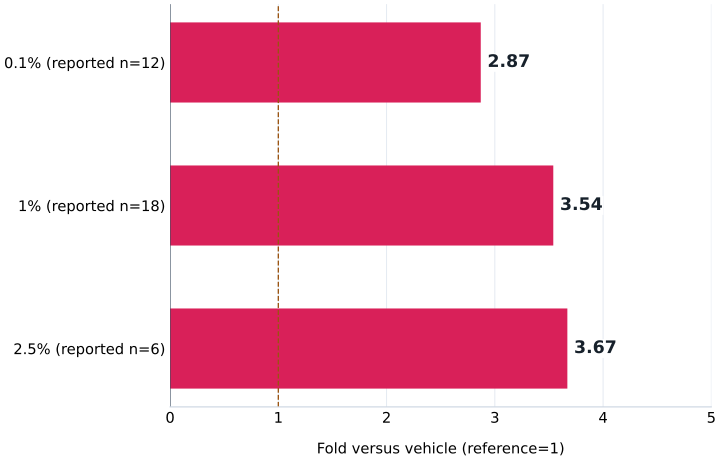
| Historical estradiol concentration | Reported value |
|---|---|
| 0.1% (reported n=12) | 2.87 |
| 1% (reported n=18) | 3.54 |
| 2.5% (reported n=6) | 3.67 |
Read the experimental map before combining results
Seventy volunteers participated overall; ten underwent facial testing. Paired hip/forearm comparisons used ethanol/propylene glycol under occlusion for roughly one week. Separate facial testing used estradiol 0.2% weight/volume in a propylene-glycol/moisturizer preparation, unoccluded, for two weeks. These details identify historical procedures; they are not directions for making or using a cream. Occlusion means covering the treated area. For interpretation, the important move is to keep the preparation and conditions together rather than borrowing a result while discarding the method that produced it.
Consider an original design example in which Preparation A is tested under Condition X and Preparation B under Condition Y. Even if the outcomes differ, that contrast does not identify which changed feature explains the difference. A study designed to examine a carrier would need a comparison that addresses the carrier question while handling the other relevant differences. Simply arranging two reports beside each other cannot create that missing comparison. A description can therefore be detailed enough to reveal differences between protocols without being sufficient to explain a causal mechanism.
Treat the skin site as part of the question
An anatomical location is not just an address attached to a measurement. It helps define what was tested. A scientific claim about one location needs an argument before it is extended to another. That argument may involve additional observations or a study explicitly designed to examine the new location. It cannot rest solely on the fact that both locations are skin. This is a general rule for transferring evidence: resemblance can motivate investigation while leaving the answer open.
Imagine a hypothetical comparison where two skin locations also differ in treatment conditions, observation time and sample selection. Calling the result a pure location effect would skip the other differences. A more disciplined interpretation describes the complete comparisons and asks which explanation the design can actually separate. The same logic applies when transferring evidence between populations: sharing a broad life-stage label is not the same as sharing all relevant study characteristics. Our companion guide to formulation details in facial-cream research provides another comparison to examine on its own terms, rather than a shortcut for merging unlike experiments.
Connect the measurement to the intended benefit
The indexed 1996 abstract describes 59 preclimacteric women, two active compounds and six months of observation; ten underwent biopsies. It reports increased type III collagen labeling and a significant prolactin increase, while noting no systemic hormonal side effects. That report gives an example of why a reading record needs separate spaces for tissue observations, clinical measurements and safety findings. A tissue sample, an instrument reading and a person's assessment of appearance answer different questions even when collected within the same investigation.
In an original reasoning example, suppose a laboratory measurement changes but the outcome that matters to a reader was never measured. The result may be relevant to a biological question without settling the practical one. To connect them, look for evidence that actually examines the desired outcome, its magnitude and its uncertainty. Do not create that connection by changing the noun in the conclusion. A claim about a precursor signal should not become a numerical promise about appearance. Likewise, a report about comfort should not be rewritten as a measurement of tissue structure.
| Question | Evidence that would address it | Inference to avoid |
|---|---|---|
| Did a laboratory marker change? | A defined assay and its comparison | Renaming the marker as a visible result |
| Was appearance different? | An appearance measure with a relevant comparison | Substituting a tissue finding for that measurement |
| Did people notice a benefit? | A specified participant assessment | Assuming an investigator's judgment answers for participants |
Leave a visible space for unresolved information
A useful evidence record distinguishes missing information from an actual contradiction. If a detail is absent, the answer may exist elsewhere, but it has not been established by the material being read. If two parts of a report disagree, choosing the more convenient version hides the problem. Record the discrepancy and limit any conclusion that depends on resolving it. Neither situation calls for inventing a value so that a comparison table looks complete.
The same care applies to sample counts. In a hypothetical project with several assays, a count attached to one analysis is not automatically a count of distinct people across the whole project. Adding analysis counts can misrepresent participation unless their relationship is known. Uncertainty deserves similar discipline: describe the interval or error measure actually reported, rather than drawing a more familiar one. These habits make the comparison auditable. Another reader should be able to trace a conclusion back to the observation and see exactly where an assumption enters, including when the appropriate answer remains unresolved.
Write the proposed comparison as a question
Start with a sentence that names the proposed preparation and the desired result. For example, an entirely hypothetical question might ask whether Preparation A improves a particular appearance rating more than its otherwise comparable base in a defined group. That sentence makes several commitments: a particular preparation, a comparison, a population and a measurement. Replacing the rating with a laboratory marker changes the question. Replacing the base with another active preparation changes it again. These are not cosmetic edits to the same scientific claim.
A useful reading exercise is to write the study question beside the question that matters to you, then underline every difference. Do not assign a score by counting matches: the missing outcome may matter more than several matching descriptive details. Instead, ask what evidence would connect each important difference. Our guide to clarifying the purpose of facial estriol and menopause treatment can help frame the clinical conversation. Here the scientific task is narrower: make the proposed comparison explicit enough that its supporting evidence can be examined.
| Field | Record from the research | Ask about the proposed comparison |
|---|---|---|
| Preparation | Identity and described formulation | Which details match, and how was that established? |
| Setting | People, skin site and testing conditions | Which differences need additional evidence? |
| Measurement | Outcome, comparator and observation time | Does this answer the intended question? |
Ask what the comparator holds steady
A comparison needs a reference that makes the scientific question clear. Comparing an active preparation with an appropriate vehicle can address a different question from comparing the active preparation with no treatment. In an original hypothetical experiment, both groups receive the same base, but only one receives the added ingredient. The comparison is intended to examine the difference associated with that addition under the tested conditions. It does not compare every possible base or establish which carrier would perform best in a separate setting.
Now change the example so that the groups also receive different packaging, instructions and accompanying products. An observed difference becomes harder to attribute to the ingredient alone. Conversely, a before-and-after observation has no simultaneous comparison group to show what might have happened over the same interval without that intervention. These are different forms of evidence, not interchangeable entries in a winner table. When reviewing the documentary questions for Alloy M4, keep any product record separate from the research comparison; the link does not establish that a commercial preparation was the one studied.
Read the denominator behind a percentage
A concentration label expresses a relationship, not a complete preparation. Weight/weight and weight/volume describe different denominators: the mass of the finished mixture in one case and its volume in the other. Naming the convention is part of naming the quantity. Two percentages written with the same digits have not been shown equivalent merely because a page leaves that convention out. This is a question about interpreting units, not an invitation to convert a prescription or calculate an amount to apply.
For a non-medical illustration, imagine two fictional laboratory catalog entries with identical percentage labels. One explicitly defines its denominator; the other does not. The correct entry in a comparison record is 'definition missing,' rather than a guessed match. Resolving that omission still would not establish that the complete preparations behave alike. Identity, composition and testing remain separate questions. Readers discussing an actual prescription can use our prescription-record questions to seek a written clarification. The answer should identify the preparation being discussed, rather than ask the reader to reconstruct it from a headline number.
Keep the observation period attached to the result
The 2026 conference pilot randomized 90 postmenopausal women aged 50–60 to three facial-cream groups; 86 completed twelve weeks. Investigator ratings were primary, while participant-rated efficacy lacked a significant between-group difference. Alloy Health funded the study. This is a different research question from a laboratory-marker investigation. It should be read with its own population, comparison and measurements, rather than treated as an automatic replication simply because estrogen appears in both descriptions.
Time also needs a place in the comparison record. In an original hypothetical example, a study observes an outcome at the final visit but does not follow participants afterward. That design does not answer how long the finding persists beyond observation. Nor can a longer study of a different preparation fill the gap by calendar length alone. Ask whether follow-up concerns continued treatment, a period after treatment or some other defined interval. Distinguishing those questions prevents a short observation from acquiring an unsupported claim about durability. It also makes clear what a future study would need to add.
Separate exposure measurements from a safety conclusion
An exposure result needs its own comparison record. The indexed 1993 abstract reports no significant serum-hormone or vaginal-smear changes among seventeen women over three months. Those findings belong to that investigation. For a comparison record, the next question is which preparation, population and measurement procedure produced each observation, not which isolated sentence sounds more reassuring. A nonsignificant finding does not, by itself, establish that a different preparation would behave the same way.
An original statistical example helps: a study designed to look for a difference is not automatically a study designed to demonstrate equivalence. A nonsignificant test alone does not establish that any difference must be small enough to dismiss. That requires a defined question and suitable uncertainty information. Likewise, a measured change in one laboratory variable does not by itself quantify every clinical risk. Our guide to interpreting blood-level claims develops the documentary questions. Keep those questions separate from personal suitability, which requires a clinician to consider the actual prescription and the person's circumstances.
Bring the evidence question into the written care record
FDA does not review compounded medicines through its premarket drug-approval process; these preparations are distinct from approved generics. Registration of a facility does not establish approval of its products. Those regulatory distinctions do not, by themselves, tell you whether a particular research comparison matches a particular prescription. The documentation task and the clinical decision remain connected but separate: identifying a preparation is necessary for discussing its evidence, while identification alone does not establish an expected benefit.
Our editorial recommendation is to request a clear written account of the proposed preparation, the goal of care and the evidence being used to connect them. If a study is mentioned, ask which part of its comparison is relevant and what additional assumptions are being made. The Midi consultation-record review can support a check of documentary terms without implying that the provider offers a studied formulation or demonstrated outcome. A useful conversation ends with the uncertainties named and responsibility for follow-up clear, rather than with a percentage being asked to carry the entire explanation.
Questions about the evidence
Does the same ingredient and percentage establish the same preparation?
It establishes a possible starting point for comparison. A useful evidence record still needs the percentage convention, the preparation's identity and the conditions in which it was studied. This is a methodological distinction: matching one entry does not supply the missing entries. Ask for documentation of the proposed match instead of inferring equivalence from two short labels.
Would different study results prove that the carrier caused the difference?
Only an appropriately designed comparison could address that causal question. In a hypothetical example where carrier, population, site and follow-up all change, the observed contrast does not separate their contributions. Listing the differences is useful because it identifies what remains to be investigated; it is not itself an experiment that identifies the responsible feature.
How should a reader use a molecular result when the goal is appearance?
Treat the result as answering its stated measurement question, then look for evidence about the desired outcome. An original interpretation should explain the proposed connection rather than assume it. If the appearance measure is absent, say that the practical question remains unanswered by that measurement. Replacing technical language with a familiar benefit would change the claim, not clarify it.
Is a missing method detail evidence that the method was poor?
No. It establishes a limit on what a reader can verify from the available account. A method may have been appropriate but incompletely reported, or the missing detail may expose a substantive uncertainty once obtained. Keep those possibilities separate. The useful next step is to identify the specific information required, rather than award either reassurance or criticism for an assumption.
What should I ask when a product page links to a study?
Ask which exact claim the link is intended to support, which preparation was tested and which differences are acknowledged. Then check whether the cited outcome matches the proposed benefit. This is an editorial approach to evaluating a reference, not a judgment about any named provider. A link makes evidence available for inspection; it does not complete the comparison on the reader's behalf.
Editorial assessment
A facial claim needs an evidence trail that reaches the face and the outcome being discussed. Reading a study carefully means preserving its anatomical setting, the meaning of its measurement and any unresolved records, then identifying what remains to be established. Historical research can make a prescribing conversation more precise by exposing those questions. It should not be compressed into a promise that omits the comparison. The practical result of this framework is a clearer evidence request: name the desired outcome, identify the relevant observation and explain each step needed to connect them.
Research access and limitations
Unresolved JAMA discrepancies: female n=17 (Table 1)/n=18 (Figure 1A); first protein dose 0.01% (figure)/0.1% (text). Randomization is unestablished. Pfizer partly funded research; Voorhees reported Pfizer consulting. The 1993 and 1996 analyses here use indexed abstracts, not full protocols; their funding and conflicts are unestablished. The 2026 report is a conference abstract. Methodological illustrations are original examples, not patient observations or preparation instructions.
Sources and access notes
Sources checked October 22, 2026. Access notes identify the material examined for this article.
- Induction of collagen by estradiol: difference between sun-protected and photodamaged human skin in vivo. ↗Primary full article: methods, main results, participant table, figure captions, discussion and funding reviewed on publisher site; formulation methods also re-read 2026-10-22 on publisher site · Checked October 22, 2026Source-register context →
- Treatment of skin aging with topical estrogens. ↗Indexed primary study abstract · Checked October 21, 2026Source-register context →
- Menopause Society 2026 abstract P-124: pilot study of estriol or estradiol facial cream ↗Original 2026 conference abstract P-124 and its complete table, PDF page50; text and rendered page reviewed · Checked October 21, 2026Source-register context →
- FDA Office of Women’s Health: menopause and estriol approval questions ↗Official FDA consumer page read directly; brief regulatory summary retained · Checked October 21, 2026Source-register context →
- FDA: Compounding and the FDA—questions and answers ↗Official FDA questions-and-answers page read directly; concise editorial summary retained · Checked October 21, 2026Source-register context →
- When applied to facial skin, does estrogen ointment have systemic effects? ↗Indexed primary study abstract · Checked October 21, 2026Source-register context →