Scientific evidence guide
Facial cream evidence: compare the formulation before the percentage
A useful research comparison keeps the ingredient, concentration convention, carrier, treatment setting and outcome together. This guide explains how to examine those connections without turning a historical experiment into instructions for using a current product.
Published October 22, 2026 · Updated October 22, 2026 · Sources checked October 22, 2026
Public-source editorial review. No clinician sign-off, firsthand product testing or individual assessment claimed.
A percentage is a compact description, which makes it an appealing shortcut when comparing a facial cream with a scientific paper. The harder question is what belongs beside that number. Which substance was measured, what was the denominator, what preparation contained it, and what comparison produced the reported result? Answering only the ingredient question leaves the rest of the research claim unfinished. A reader needs a description of the tested intervention before deciding whether another preparation is meaningfully comparable.
Our approach is to build that description one field at a time. The reasoning examples below are editorial illustrations, not additional clinical findings or directions for preparing or applying hormones. They separate a documented match from a difference and an unanswered question. That distinction is useful because an incomplete comparison does not establish either equivalent performance or inferior performance. It identifies the evidence still needed. The aim is a more precise conversation about a proposed claim, with the original study and the current product record kept identifiable throughout.
In this reading
Study figure and data
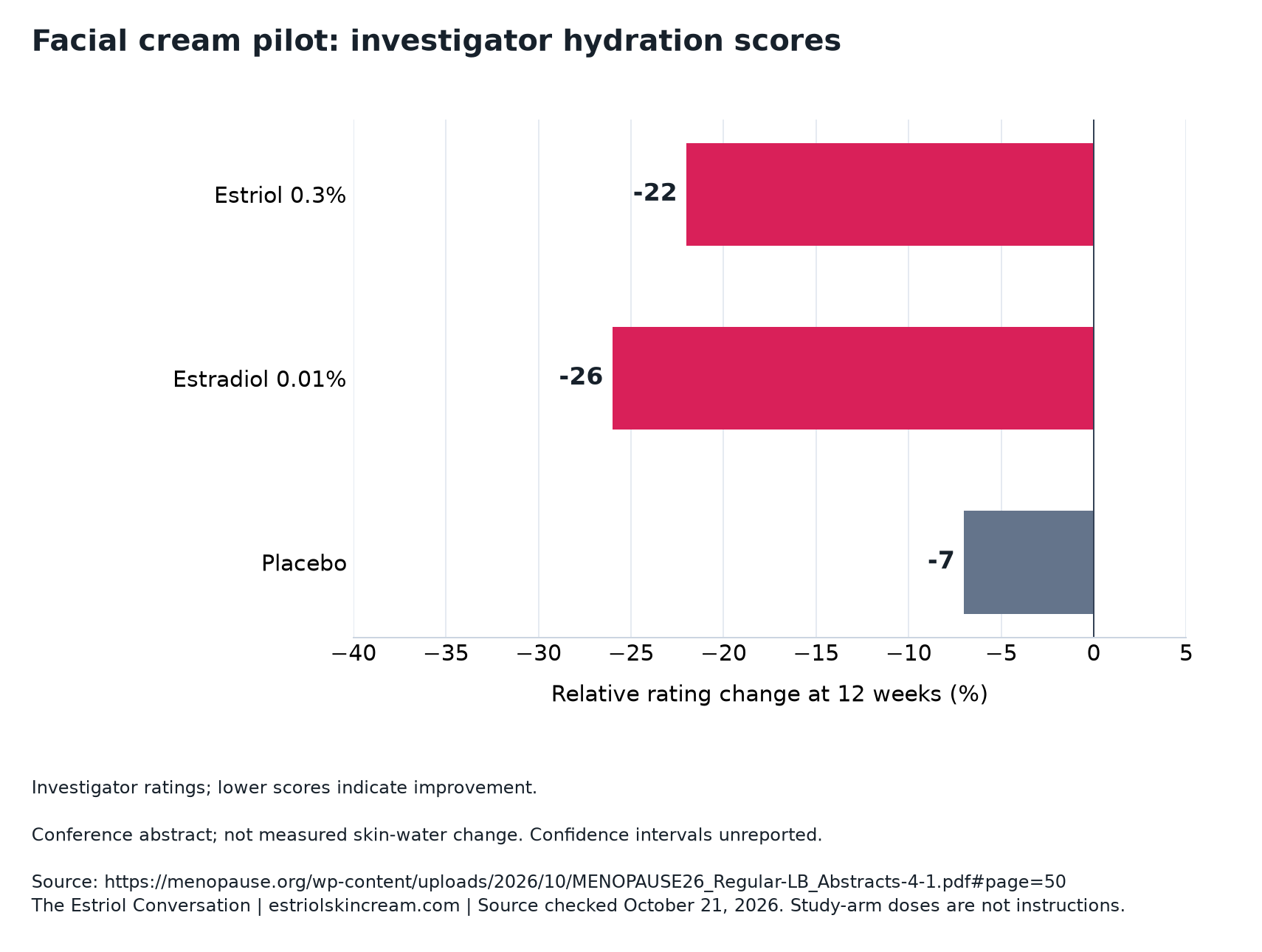
Facial cream pilot: investigator hydration scores
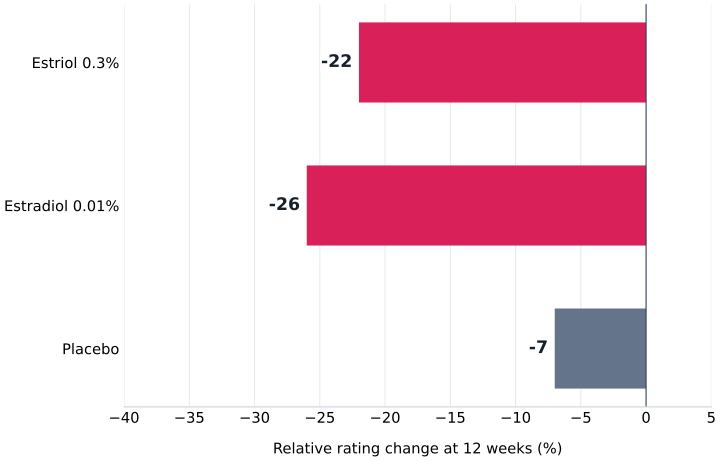
Investigator ratings; lower scores indicate improvement.
Conference abstract; not measured skin-water change. Confidence intervals unreported.
Download chart (PNG)Download data (CSV)Download vector chart (SVG)
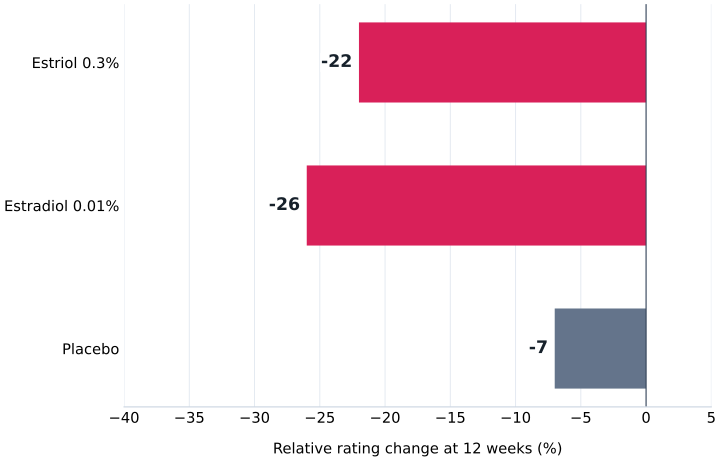
| Historical trial arm | Reported value |
|---|---|
| Estriol 0.3% | -22 |
| Estradiol 0.01% | -26 |
| Placebo | -7 |
Build an identity for the tested preparation
Conference abstract P-124 reports 90 postmenopausal women randomized for 12 weeks, with blinding and placebo control; Alloy funded it. Complete base and percentage convention are unreported. Serum comparisons were nonsignificant, and tolerability scales reported no issues. Neither establishes zero absorption or long-term safety. The plotted scores are investigator ratings.
A formulation comparison should begin with two separate records: one for the research intervention and one for the preparation being discussed now. Copy only documented characteristics into each. An ingredient match belongs in the ingredient field; it should not automatically fill the carrier, manufacturing or clinical-outcome fields. This is an editorial method for organizing an argument, not a test that validates a product.
Consider a hypothetical article that identifies an active ingredient while a current label identifies the same ingredient and a detailed base. The extra label detail does not recover what the article omitted. The correct entry remains unknown on the research side. Our prescription-record questions provide a place to keep that missing connection visible when requesting a written explanation.
Ask what the percentage divides
A percentage expresses one quantity relative to another. Its interpretation requires both parts of that relationship. Weight relative to weight and weight relative to volume answer different measurement questions, even when the printed numeral looks identical. A unit convention is therefore part of the preparation description, not a decorative addition to a number.
For a deliberately nonclinical illustration, imagine two laboratory records displaying the same percentage but omitting the denominator in one record. It is impossible to establish a numerical match by comparing the digits alone. Adding a conversion would require the appropriate physical information, rather than an assumption that a volume and a mass are interchangeable. This example supplies no formula, application amount or instruction for a hormone product.
There is a second distinction after the convention is known: a concentration describes a preparation, whereas an exposure claim describes what happened under a particular protocol. Moving from one to the other needs evidence about that protocol. When checking documentary language in the CoreAge Rx Time Out review, use a percentage as a question to clarify, without treating this link as evidence that any research preparation matches that provider’s product.
| Field | What a matching entry would establish | What would remain unresolved |
|---|---|---|
| Ingredient identity | The named substance matches | The rest of the preparation and its performance |
| Percentage convention | The numerator and denominator use the same convention | Exposure under the proposed conditions |
| Carrier description | The documented base can be compared | A causal explanation for any outcome difference |
| Outcome definition | The same kind of measurement is being discussed | Whether the treatment effect is comparable |
Separate carrier differences from explanations
The 2008 full article describes ethanol/propylene-glycol vehicle under occlusion for hip and forearm experiments, but estradiol in a propylene-glycol-containing moisturizer without occlusion for the face. The facial concentration is specified as weight/volume. These were distinct protocols, not an isolated test of carrier effects. Pfizer partly funded the work; a coauthor disclosed Pfizer consulting.
Occlusion means covering the treated area. Its presence belongs in the protocol record alongside the carrier and anatomical site. In a methodological comparison, changing several of these fields simultaneously prevents a simple attribution to just one. Even a plausible explanation would still need a design capable of distinguishing it from the other changes. Naming a solvent is not that design.
A hypothetical experiment could hold the population, measurement and treatment setting constant while deliberately comparing two carriers. Another could investigate covering separately. Those examples describe questions a study might address, not established mechanisms or suggested home experiments. Our companion analysis of protected skin and facial-product comparisons follows the anatomical part of the evidence chain. Keep the carrier question open unless it is actually isolated by the comparison.
Let the control determine the claim
A treatment result is a comparison, even when a headline presents only one number. A matched vehicle control is intended to make the contrast more specific than an untreated comparison. A before-and-after observation instead compares different times in the same treatment sequence. These approaches can be informative, but their numerical results do not have the same interpretation merely because the active ingredient has the same name.
In an invented example, suppose a score improves in both a test group and a comparison group. The change in the test group alone includes everything that happened during follow-up. The difference between the group changes addresses a narrower question. This arithmetic distinction remains important even before asking why either group changed. It does not assign the comparison group’s change to a particular ingredient or procedure.
For a formulation claim, identify exactly which contrast is being transferred. Is the claim about an added ingredient relative to its control, or about the whole preparation relative to an earlier measurement? The provider-comparison questions can help request that distinction in writing. A statement that a cream was studied needs its comparator beside it before the statement becomes scientifically informative.
Keep the measured quantity in the sentence
A rating, a physical measurement and a molecular assay each describe a different quantity. Their interpretation depends on how the outcome was obtained. A reader should be able to complete a short sentence: the investigator measured this characteristic, with this method, at this point in the comparison. Replacing the characteristic with a more attractive one changes the claim, even if the result retains its original number.
Imagine an illustrative report in which a rating falls while a separately measured physical quantity changes little. There is no mathematical contradiction unless the two measurements were defined as interchangeable. A rating can classify an observation; a physical measure can quantify a different property. Agreement, disagreement and correlation would themselves require analysis. One measurement should not be quietly renamed as the other to simplify a headline.
The same discipline applies to molecular outcomes. A change in a biological marker is evidence about that marker under the tested conditions. An appearance claim introduces an additional outcome that must be evaluated rather than presumed. Our blood-level claim guide applies this reading habit to another measurement context. The useful question is not which result sounds most impressive, but which result addresses the stated concern.
Read older preparation names literally
The 1993 indexed abstract describes ointments in 17 women over three months; serum and vaginal-smear comparisons were nonsignificant. The 1996 indexed abstract describes two active compounds in 59 preclimacteric women over six months; prolactin increased. Neither indexed abstract supplies a complete formulation or establishes randomization, blinding or a vehicle comparator. Funding is unavailable in these indexed records.
A preparation category is a starting description, not an exhaustive identity. As an editorial reading exercise, put the historical term in one field and the documented ingredients in another. A broad category does not justify filling an absent ingredient list from a modern example. Conversely, an unfamiliar historical name does not establish that a preparation is fundamentally different from every current one. Both conclusions would go beyond the available comparison.
Evidence access also matters. Reading an indexed abstract permits analysis of its reported information; it does not establish what a full protocol might contain. The practical next step is to request the missing record, not to reconstruct it from assumptions. The medication-list discussion guide offers a separate way to organize an individual clinical conversation without treating an older research description as a current prescription.
Distinguish repetition from a new experiment
A replication claim asks whether an earlier question was tested again under sufficiently comparable conditions. A new formulation question asks what happens after an intervention characteristic changes. Both are legitimate research aims. Confusion arises when evidence answering the second question is presented as if all the conditions of the first were preserved.
The table below is an original decision aid, not a scoring system validated in patients. It separates the state of a comparison from a judgment about efficacy. A known difference invites a question about whether the difference matters. An unknown entry invites a request for documentation. Neither should be assigned a penalty that implies a measured loss of benefit. That would turn incomplete information into an invented clinical estimate.
A useful comparison can therefore remain partly unfinished. For example, a hypothetical pair of records might match the named molecule and the endpoint, differ in carrier, and omit the concentration convention in one report. The result is a mixed record, not a percentage of equivalence. Counting matching fields would give equal numerical weight to factors whose relevance has not been established by such a count.
| State of the field | Appropriate next question | Unsupported shortcut |
|---|---|---|
| Documented match | Does this match address the claim being made? | Assume every other field also matches |
| Documented difference | Was the difference studied or otherwise justified? | Declare the changed preparation better or worse |
| Information unavailable | Can the underlying method or record be obtained? | Treat missing information as evidence of sameness |
| Different outcome | What evidence connects the two outcomes? | Reuse the result under a new outcome name |
Treat follow-up as part of the experiment
A protocol includes a time structure: when treatment occurred, when a measurement was taken, and how long observation continued. These are distinct fields. A measurement at the end of an experiment does not describe every moment before it or any period afterward. Extending the conclusion beyond the observation window introduces another inference that needs its own support.
Consider an original sampling illustration. One investigation might collect a measurement at a single visit; another might collect repeated measurements surrounding that visit. Even if the visit values agree, the first record cannot describe fluctuations that it never sampled. This is a limitation of observation, not proof that fluctuations occurred. The same distinction helps avoid interpreting an unobserved event as either present or absent.
Safety questions also need the event being considered and the method used to look for it. A tolerability question and a long-term clinical outcome question require different evidence. For a personal discussion, distinguish those questions before selecting a paper as an answer. Our guide to facial treatment and menopause treatment purposes helps make the intended purpose explicit without converting a study schedule into a recommendation.
Specify what would count as a meaningful difference
Two results may look similar without having been tested for equivalence. In a conventional difference test, a nonsignificant result means the analysis did not meet its criterion for detecting a difference. An equivalence question instead needs a justified range of differences considered acceptably small and an analysis that evaluates the estimate against that range. The questions are related, but they are not interchangeable.
As a purely illustrative comparison, imagine that a reader would consider a small discrepancy unimportant but a much larger one important. An uncertain estimate spanning both possibilities would not settle the reader’s question, even if its central value looked reassuring. The uncertainty belongs in the answer. This reasoning does not supply a clinical threshold or calculate an interval that a study did not report.
A formulation-transfer argument needs the same precision. Which outcome must be sufficiently similar, under which conditions, and within what justified margin? A match in label wording cannot answer that statistical question. Nor can several individually nonsignificant comparisons be assembled into a blanket statement that all relevant outcomes are equivalent. Write the proposed conclusion first, then ask whether the available design and measurements actually test it.
Keep research, product records and approval distinct
FDA states that no estriol-containing drug is approved. Compounded medicines lack FDA approval and do not undergo its premarket evaluation of safety, effectiveness and quality. Registration of a facility is not approval of a particular product. These regulatory facts do not determine an individual person’s suitability for treatment.
Research evidence, the current product record and a regulatory status answer different questions. As an editorial approach, keep a separate entry for each rather than asking one document to stand in for all three. A study describes its intervention and observations. A current record identifies the preparation under discussion. A regulatory statement addresses the relevant approval question. None automatically supplies the missing details of the other two.
A documented research funder likewise belongs in the funding record. Funding alone does not identify a current retail preparation as the tested intervention. The Alloy prescription-record review is a place to check documentary questions, not an assertion of a formulation match. A useful written answer should identify the exact connection being claimed and the evidence for that connection, leaving unanswered fields visible rather than replacing them with a general assurance.
Questions about the evidence
Does matching the ingredient and percentage establish the same studied cream?
It establishes only the matches that were actually documented. The denominator convention, carrier and protocol remain separate comparison fields. This is a reasoning rule rather than a finding that every change matters clinically: the consequence of a particular change needs evidence of its own. Keep identity and performance as separate questions.
Should an unknown carrier be treated as a poor-quality formulation?
No. Unknown describes the available information, not a measured property of the preparation. Record what is missing and seek the underlying documentation. Assigning a quality judgment from that gap alone would add a conclusion the comparison has not tested. A complete ingredient description would resolve an information gap, not by itself prove efficacy.
Can a different result be blamed on the base cream?
Only a comparison capable of distinguishing that explanation from other changes could support such an attribution. If site, carrier and protocol differ together, selecting the carrier as the cause is an additional hypothesis. A plausible explanation should remain labeled as a hypothesis until the relevant evidence tests it.
How should I describe a study when only its abstract is accessible?
Identify the accessible report as an abstract and distinguish reported information from questions it leaves unanswered. Avoid assuming that a missing detail was absent from the original work. Equally, do not fill the gap with a method from another study. Those habits preserve a useful boundary between reading and reconstruction.
What written answer would make a product comparison more useful?
Ask which specific study intervention is being compared, which characteristics match, which differ, and which remain undocumented. Then ask what measured outcome supports the proposed claim. These are documentary questions, not a substitute for a prescribing assessment or instructions to change treatment. A qualified comparison can be useful while still acknowledging unresolved fields.
Editorial assessment
The strongest formulation comparison is explicit about its units of comparison. It identifies an intervention, a control, an observation period and an outcome before considering transfer to another preparation. Our interpretation is that a clearly documented gap is more useful than a confident but incomplete equivalence claim: it tells the next reader exactly what evidence to request. This approach does not select a hormone product or estimate an individual benefit. It makes the scientific argument inspectable, so a matching ingredient name remains one documented connection rather than a substitute for the entire chain.
Research access and limitations
The illustrative records and decision aid are original educational constructions, not patient observations, validated prediction tools or preparation instructions. They explain how to inspect an argument without estimating treatment effects for an individual.
Sources and access notes
Sources checked October 22, 2026. Access notes identify the material examined for this article.
- Menopause Society 2026 abstract P-124: pilot study of estriol or estradiol facial cream ↗Original 2026 conference abstract P-124 and its complete table, PDF page50; text and rendered page reviewed · Checked October 21, 2026Source-register context →
- Induction of collagen by estradiol: difference between sun-protected and photodamaged human skin in vivo. ↗Primary full article: methods, main results, participant table, figure captions, discussion and funding reviewed on publisher site; formulation methods also re-read 2026-10-22 on publisher site · Checked October 22, 2026Source-register context →
- Treatment of skin aging with topical estrogens. ↗Indexed primary study abstract · Checked October 21, 2026Source-register context →
- When applied to facial skin, does estrogen ointment have systemic effects? ↗Indexed primary study abstract · Checked October 21, 2026Source-register context →
- FDA Office of Women’s Health: menopause and estriol approval questions ↗Official FDA consumer page read directly; brief regulatory summary retained · Checked October 21, 2026Source-register context →
- FDA: Compounding and the FDA—questions and answers ↗Official FDA questions-and-answers page read directly; concise editorial summary retained · Checked October 21, 2026Source-register context →